
In short
A good uncle gift does one of two jobs. It either matches something he already likes, like the grill, the whiskey, or a gadget, or it proves he is somebody's uncle. Almost every guide online does the first, usually with a slogan mug. The second is the one almost nothing is built for: a keepsake starring his actual niece or nephew, which is the one gift on this page he cannot buy for himself.
Two very different people search for uncle gifts. One is a grown nephew or niece buying for the guy who taught them to fish. The other is a parent shopping on behalf of a four-year-old who cannot spell "uncle" yet. Most guides are written for the first and pretend the second does not exist. This one covers both, with real prices, honest order-by dates, and a plain warning about which picks are worth skipping. Some of what follows we do not sell, which is rather the point.
What makes a good gift for an uncle?
A good uncle gift answers a question he is quietly asking: does this person actually know me, or did they just know I am an uncle? A "Best Uncle Ever" mug answers the second. Gifts for uncles sort into four categories, and they are not equally served. There is his taste, meaning the whiskey glass, the good knife, the record. There is his hobby, meaning the grill tools or the camping gear. There is his uncle-ness, which is where the "Funcle" swag lives. And there is the kid, which is the category almost nothing is built for.
That fourth one is not sentimentality for its own sake. In a 2005 study in the Journal of Marriage and Family, based on in-depth interviews with 21 uncles and 31 nephews in Wellington, New Zealand and Bangor, Maine, researcher Robert Milardo found that uncles described themselves as "supplements to parents, as friends, or as surrogate parents," acting as mentors, as intergenerational buffers, and as family historians. The study is small and qualitative, so treat it as texture rather than a rule. But it suggests the relationship an uncle values most is the one with the kid, which is exactly the relationship the swag ignores.
The one gift category the big guides skip
Look closely at what "sentimental" means on the major uncle guides and a pattern appears: it almost always means his name, or a joke about him. His monogram on a whiskey glass. His initials seared into steak by a branding iron. "Funcle" on a crewneck. That is personalized to the uncle as a guy, which is genuinely fine, but it is silent about the one thing that makes him an uncle in the first place.
The stranger part is that the mechanic already exists on these pages, just pointed elsewhere. One popular "uncle who has everything" guide merchandises a custom puzzle, then makes it a puzzle of his favorite landmark. A major women's-magazine guide files its one "sentimental gift from his niece" under a slogan blanket that reads "Best Uncle" and an uncle-and-nephew keychain. Another runs a whole "Sentimental Gifts for Uncles" section and leads it with an engraved but empty picture frame and a shirt printed with cartoon avatars of the family, not the actual kids.
So the gap is not that the idea is unheard of. It is that nobody merchandises the real child, at this age, as the hero.
Why do we talk ourselves out of the sentimental gift?
Because giving one feels risky, and the research says that instinct misfires. In a 2017 scenario-based study by Julian Givi and Jeff Galak, published in the Journal of Consumer Psychology, participants imagined giving a friend one of two framed photos: one of the friend's favorite musician, and one of the two friends together on a day they had fun. Givers chose the sentimental photo 63% of the time for a birthday and 76% of the time for a going-away party. Meanwhile 79% and 96% of recipients respectively said the sentimental photo was the one they would rather receive.
The gap is not that givers are careless. It is certainty. Per the authors, givers feel relatively sure that a preference-matching gift will land, and relatively unsure about a sentimental one, so they take the safe road. Worth keeping in proportion: these were hypothetical scenarios rather than observed gift exchanges. But the direction is consistent, and it explains the empty shelf better than his taste does.
How much should you spend on an uncle?
More than you think is unnecessary, and less than you fear is fine. A reasonable working band: $25 to $50 for a warm gesture, $50 to $120 for a considered gift or a milestone like a brand-new uncle or a big birthday. Above that you are usually buying for yourself.
Price is also a weaker lever than it feels. In a 2009 study by Stanford researchers Francis Flynn and Gabrielle Adams in the Journal of Experimental Social Psychology, givers expected appreciation to rise with what they spent, on the assumption that price signals thoughtfulness. Recipients reported no such link. The work rests on two surveys plus a hypothetical scenario rather than three observed exchanges, and later research complicates the flat reading, with some arguing the null is the net of price helping while conspicuous spending triggers suspicion. Treat it as a caution against over-spending, not proof that cheap wins.
For context on the season, Deloitte's 2025 Holiday Retail Survey of 4,270 US consumers found the average shopper planned to spend $505 on gifts, down 6% from $536, while planning to cut non-gift purchases like hosting, clothing, and decor by 22%. People protected the gift budget and trimmed the trappings around it.
What is the 5 gift rule for adults?
It is a folk framework, not a research finding, and it is worth saying so plainly. The usual form is something they want, something they need, something to wear, and something to read. Some households add a fifth slot, most often something to do or an experience. It circulates as a parenting budget framework for children's Christmas lists and gets stretched to adults. No source traces it to a single inventor, and we found no research behind it.
Its real use for an uncle is as a portfolio check rather than a shopping list, because most people fill the want, need, and wear slots easily and leave the last one empty. That empty slot is exactly where a keepsake goes. Map it and it gets concrete fast: wear is a good pair of socks, read is a book he would not buy himself, and the open slot is the thing with his nephew in it. For scale, Deloitte found the average shopper expected to buy 8 gifts in 2025, down from 9, so a rigid five-slot rule is a stretch against how people actually plan.
Gifts for uncles by budget
Every price below is real and current. The picks we do not sell are here because they are genuinely good, and a guide that only recommends its own shelf is not a guide.
A fill-in "what I love about my uncle" book, a good pair of wool socks, an engraved bottle opener. Our honest entry here is the $5 digital portrait: it is a file, not an object. He sets it as a phone background or prints it himself. If he would rather hold something, skip to the next tier.
A YETI-style tumbler, or a whiskey glass if he does not already own six. On our side: a jigsaw puzzle from $45, an 8" x 10" gallery-wrapped canvas at $49, or a 30" x 40" fleece blanket at $49.
The considered tier the big lists thin out on. A framed canvas runs $69 (8" x 10"), $89 (11" x 14"), or $119 (16" x 20"), in Black, Espresso, White, or Natural. A 50" x 60" blanket is $69. A 520-piece puzzle is $65.
Our ceiling is the 16" x 20" framed canvas at $119, and it is a ceiling on purpose. Given how weakly price tracks appreciation, spending past this band buys you reassurance, not his delight.
Which uncle are you shopping for?
The segmentation most guides promise in the intro and then quietly drop. Sort by his relationship to the kids, not by his hobby, and the right gift falls out fast.
The uncle who is around every week, coaches the team, runs the fishing trip. He already has the gear. What he does not have is proof of the bond, which is what a keepsake of the kid is for.
The strongest case on this page. He sees the kids twice a year. The real question is what is in his house the other 363 days, which is an argument for the wall, not another gadget.
Nothing off a shelf, because the shelf is the problem. Something that did not exist until you made it is the only category he cannot already own.
The trap: "fun uncle" swag is the least fun gift available, and it is the same mug in nine different fonts. If he is the fun one, give him the loud thing the parents would not buy.
Godfather, honorary uncle, brother-in-law. The bond is elective, which is exactly why proof of it lands. This is the same problem one generation up.
If his fur nephew is the actual relationship, that is the right subject. A pet portrait renders a dog or cat as a costumed persona, and it costs the same as any other.
There is a dated but striking observation behind the long-distance case. When researchers interviewed 315 people across 82 Chicago-area families in 1977, published as Mihaly Csikszentmihalyi and Eugene Rochberg-Halton's 1981 book The Meaning of Things, photographs came third overall as a cherished object category, behind furniture and visual art, and the attachment deepened with age: 10% of the children named photographs among their special things, against 22% of their parents and 37% of their grandparents. That study is cross-sectional, pre-digital, not nationally representative, and about objects people already owned rather than gifts they received, so hold it loosely. It still points somewhere true: the things people keep tend to be the things with people in them.
Gifts for an uncle and his partner
A couple gift has a constraint nobody names: it has to live in a shared room. That single rule kills most of the personal-taste picks above. The whiskey glass is his alone. A monogram does not work, because whose initial goes on it? Cologne, a razor kit, and a golf gadget are all gifts for one of the two people with the other's name on the card.
What survives is the wall, the couch, and the coffee table. A framed canvas of the kids works in a living room in a way a grill accessory does not. A blanket is shared by definition. A puzzle turns into a two-person activity over a holiday weekend and then goes in a frame if it is good. If you are shopping the other direction, for his sister, the companion guide to gifts for aunts runs the same logic from her side, so a matched pair of keepsakes is an easy set.
Christmas gifts for uncle
Google's Keyword Planner puts searches for uncle gifts at about 1,000 a month in summer, climbing to 12,100 in December, more than a tenfold jump. We read the guides ranking for the term today. One promises Christmas in its headline and fills the "sentimental" slot with a funny mug. Another was published in the thick of the season and still offers no shipping guidance at all. Not one of the uncle guides we read tells you when to order a made-to-order gift.
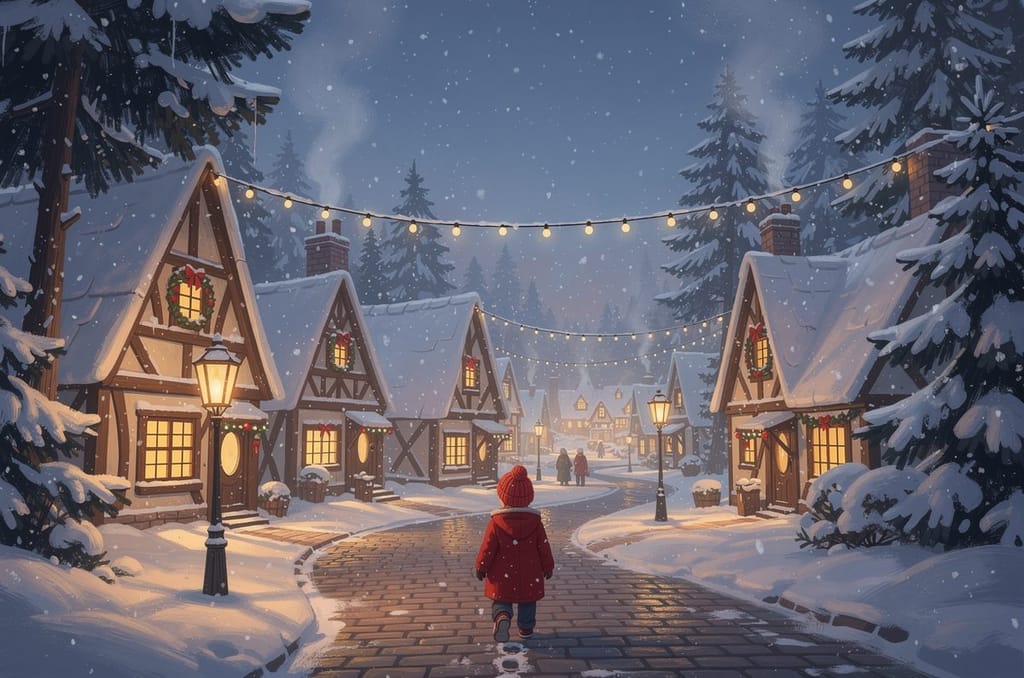
Made-to-order gifts run on a different clock than Amazon. A portrait is not sitting in a warehouse, so the timeline is make time plus transit, and the clock starts when you approve the proof, not when you place the order. A Christmas Village portrait is the seasonal pick, though a world he associates with the kid, a Space Explorer or a Big Catch fishing scene, beats a seasonal one most years.
When do you need to order a personalized gift by?
Order-by timing
Orders arrive in about 5 to 10 business days after you approve your proof, and approving takes most people a day. Working backward from December 25, order custom pieces by the first week of December to be comfortable. If you have already missed it, the $5 digital portrait is delivered as a file, so it works at 11pm on the 24th: print it, frame something you own, or email it as a card with the physical piece to follow.
What is an uncle actually for?
Worth knowing what an uncle thinks he is for, because it tells you what a gift should say. In that same 2005 study, uncles cast themselves as mentors and family historians, the ones who hand down the stories, teach the thing the parents are too busy to teach, and stand a little outside the daily discipline. Milardo's own frame was generativity, the concern for the next generation that the psychologist Erik Erikson described as a core adult drive.
Read that way, the right gift is not one that flatters the uncle. It is one that puts the next generation in his hands. A portrait of his niece or nephew as the hero of a world does exactly that: it is the kid, at this specific age, made permanent, which is the job an uncle already believes is his. It reads as belonging to him in a way a "World's Best Uncle" mug never manages, because the mug is about him and the portrait is about the thing he actually cares about.
What if the gift is really from the kids?
Then it is different, not better, and the distinction matters. A gift from a four-year-old is executed by a parent, and both people know it. What the child supplies is the reason, not the logistics. Nobody is fooled, and nobody minds.
This is also the direction the research is least kind about. In a 1993 study in the American Economic Review, based on surveys of Yale undergraduates, economist Joel Waldfogel found that noncash gifts from extended family were the least efficient of any giver type, destroying roughly a third of their value, and that aunts, uncles, and grandparents were both the lowest-yield givers and the most likely to fall back on cash. Fair warning before anyone takes that as gospel: the finding is genuinely contested. A 1996 comment in the same journal by Sara Solnick and David Hemenway found the opposite. Replicating the survey with adults recruited at train stations and airports, along with faculty, staff, and graduate students at Harvard, they reported that recipients valued their gifts at more than twice what the givers had paid, meaning gift giving created value rather than destroying it. The lesson is not that uncle gifts are doomed. It is that a generic one is the risk, and specificity is the fix.
How does a custom portrait keepsake actually work?
Start with one photo of the child. A clear face, decent light, looking toward the camera. A phone photo is fine, and how to pick a photo that renders well covers the rest.
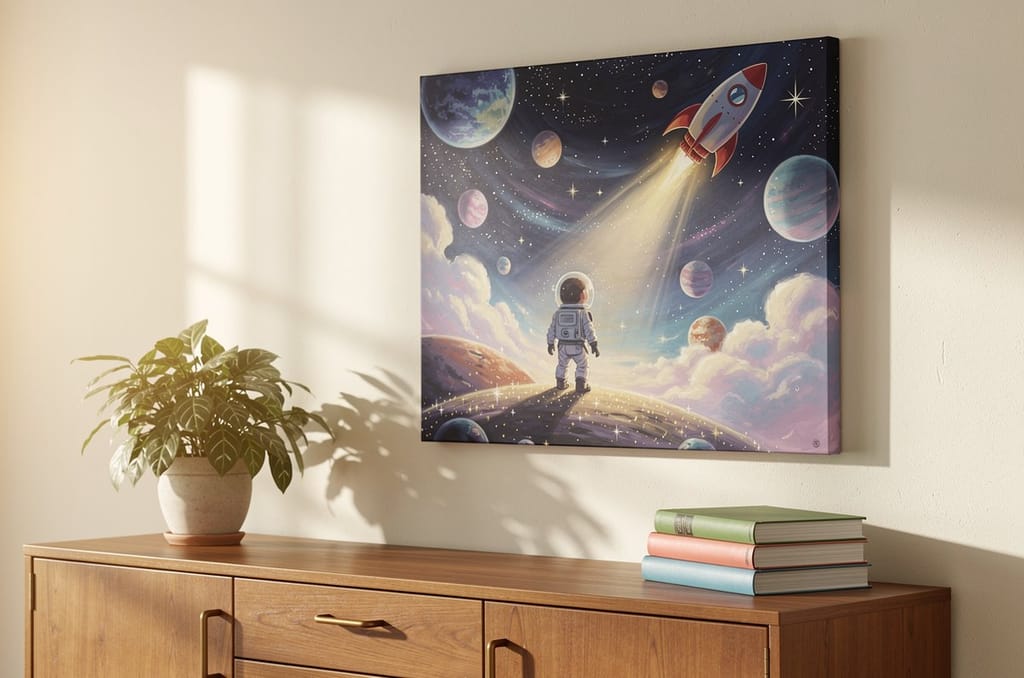
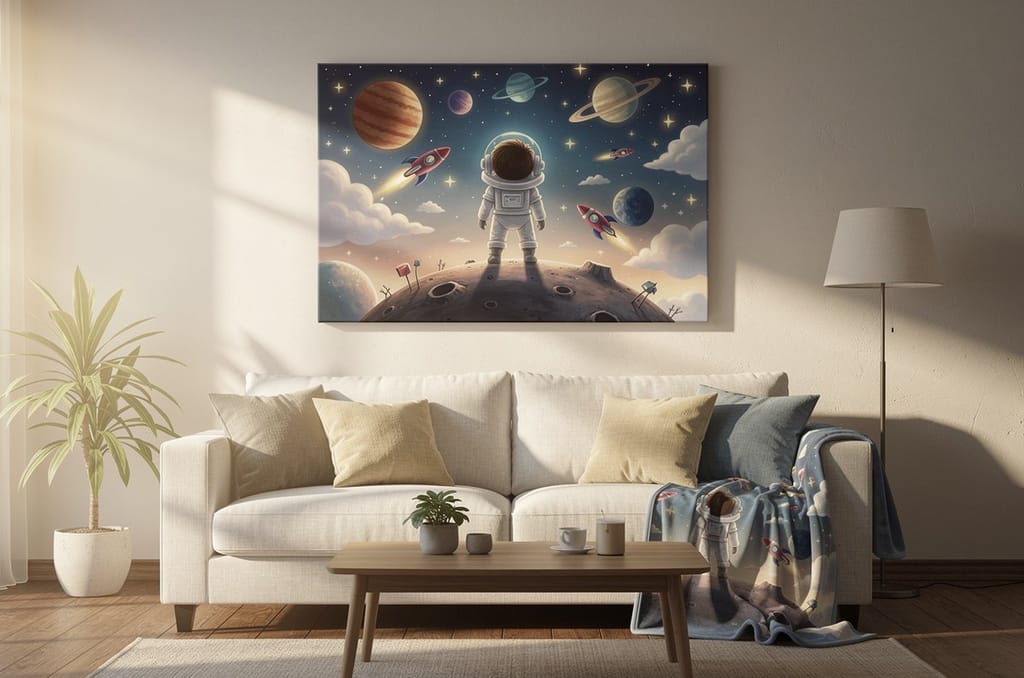
Then pick a world. The child gets repainted as its hero while keeping their real face, hair, and skin tone, across worlds including Space Explorer, Dragon Kingdom, Dino Expedition, Superhero City, and Christmas Village. A family mode renders a family photo in an art style you choose, and a pet mode renders a pet as a costumed persona. The same approved portrait then prints as a framed canvas, a gallery-wrapped canvas, a jigsaw puzzle, or a fleece blanket, so you pick the format after you like the art. If you want the mechanics, here is the full walkthrough of how the portraits are made.
What happens to the photo
You approve a watermarked proof before anything prints. The uploaded photo is automatically and permanently deleted within 24 hours of fulfillment, it is never used to train AI models, and the child's name is never sent to the image model. US shipping is free, a watermark-free digital copy of the portrait comes with every physical order, and if it arrives damaged we reprint it free.
What to skip
One recurring uncle guide promises gifts he will actually love and then recommends a tumbler, a beard kit, and a bottle opener shaped like a joke. Here is the version with follow-through.
Worth it
- Anything with the kids in it, at any price
- One good thing in his taste, chosen specifically
- A shared object for him and his partner
- The right puzzle piece count for the right age
Skip
- The tenth "Best Uncle Ever" mug, if anyone has given uncle swag in three years
- Anything that evaporates, unless evaporating is the point
- Trend gadgets that are already in a drawer by February
- An empty engraved frame you never fill with a photo
On that last one, the empty frame is a real pick on a real uncle guide, filed under sentimental. It is the right instinct with no follow-through. If you buy the frame, fill it.
The evaporation point deserves a caveat, because the honest version cuts against the easy story. In a 2017 study in the Journal of Consumer Research, Cindy Chan and Cassie Mogilner found experiential gifts strengthened relationships more than material ones across four studies. But their fourth study also found that material gifts which stir intense emotion do just as well, and the authors' own examples of that are an engagement ring and a photograph that captures a meaningful moment. The lever is emotional intensity, not whether the gift is a thing.
Give him the one gift he can't buy himself
Upload one photo and his niece or nephew becomes the hero of a world they love. Approve a free, watermarked proof before anything prints.
Frequently asked questions
What is a good gift for an uncle?
+
A good uncle gift either matches his actual taste or proves he is somebody's uncle. The first is well covered everywhere. The second is the gap: a keepsake starring his niece or nephew, like a framed canvas from $69 or a puzzle from $45, is the one thing on any uncle list he cannot buy for himself.
What do you get the uncle who has everything?
+
Nothing off a shelf, because the shelf is the problem. The only category he cannot already own is something that did not exist until you made it: a portrait of his specific niece or nephew, at this specific age, as the hero of a world they love. A framed canvas runs $69 to $119.
How much should you spend on a gift for your uncle?
+
$25 to $50 for a warm gesture, $50 to $120 for a considered gift or a milestone. Spending more is a weaker lever than it feels: in a 2009 study in the Journal of Experimental Social Psychology, givers expected appreciation to rise with price while recipients reported no such link.
What is the 5 gift rule for adults?
+
Something they want, need, wear, and read, plus a fifth slot that varies, commonly something to do or something sentimental. It is a folk budgeting framework that started with children's Christmas lists, not a research finding. Its real use is as a check: most people leave the fifth slot empty, and that is where a keepsake belongs.
What is a good Christmas gift for an uncle?
+
Something that lasts past the season and has the kids in it. A framed canvas of his niece or nephew as a storybook hero starts at $69, a fleece blanket at $49, and a puzzle at $45. A Christmas Village portrait suits the holiday, though a world he associates with the child usually beats a seasonal one.
When do I need to order a personalized gift to get it by Christmas?
+
Order custom pieces by the first week of December. Made-to-order gifts arrive in about 5 to 10 business days after you approve your proof, and the clock starts at approval, not at checkout. If you have missed it, the $5 digital portrait is delivered as a file and works the same night.
What is a good gift for an uncle and his partner together?
+
Something that lives in a shared room. Cologne, monograms, and a single whiskey glass are gifts for one of them with the other's name on the card. A framed canvas of the kids, a fleece blanket from $49, or a puzzle that becomes a two-person activity all work because both people own them equally.
What is a good gift for an uncle from a young niece or nephew?
+
A gift from a young child is executed by a parent and everyone knows it, so the child supplies the reason rather than the logistics. A keepsake starring the child fits perfectly here: it is honestly from them, and research on gift exchanges suggests givers underrate sentimental gifts relative to how much recipients want them.
What kind of photo do I need for a custom portrait?
+
One photo of the child with a clear face, decent light, and their eyes toward the camera. A phone photo is fine. You do not need a professional shot, and you approve a watermarked proof of the finished portrait before anything prints, so nothing is committed until you like it.
What happens to the photo after I order?
+
It is automatically and permanently deleted within 24 hours of fulfillment. It is never used to train AI models, and the child's name is never sent to the image model. You approve a watermarked proof before printing, so you control exactly how the keepsake looks before it exists.
Still deciding? See how the portraits are made, or upload a photo and pick his nephew's world.